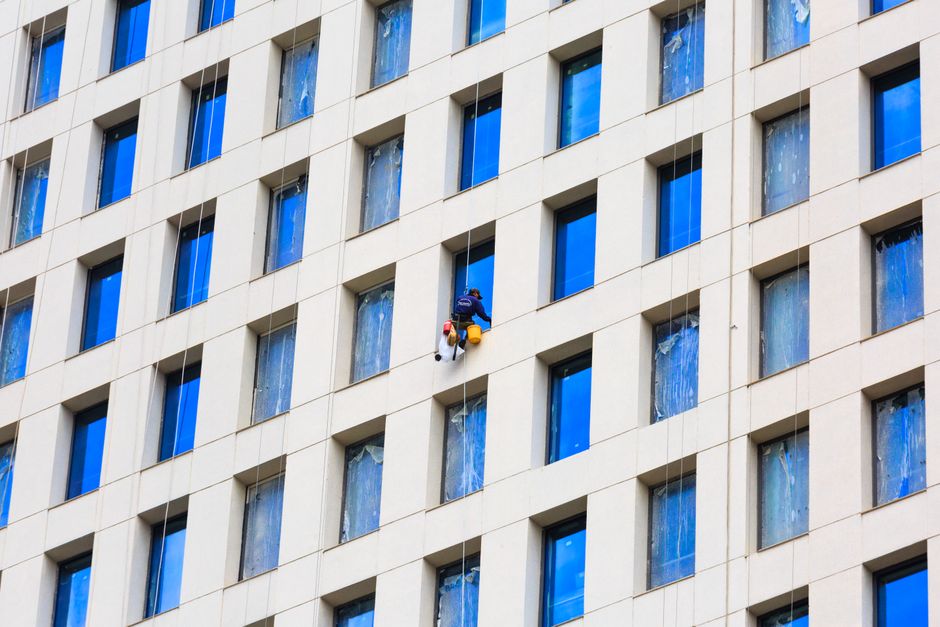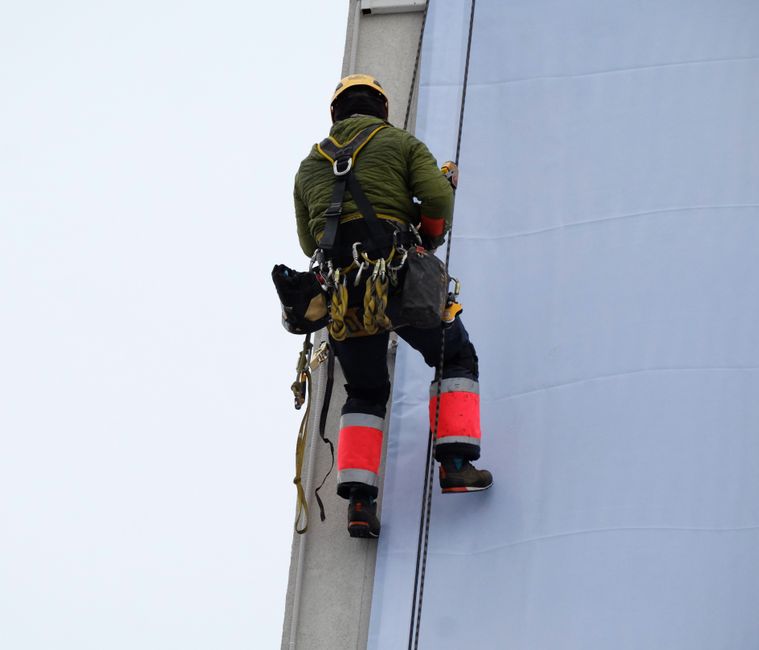
Professional window cleaning on high-rise buildings requires a combination of specialized equipment and structured techniques. Rope access systems, including certified harnesses, ropes, and anchors, form the foundation of safe work at elevated heights. Unlike scaffolding or aerial lifts, rope access allows cleaners to move vertically and horizontally across a facade with precision, while minimizing the footprint on the ground. These systems are designed to support the worker’s weight and provide fall protection in the event of a slip or equipment failure.
The procedures involved in rope access window cleaning are governed by industry standards that emphasize redundancy, inspection, and proper training. Each component of the system, from the harness to the carabiners, must meet certification requirements set by organizations such as ANSI (American National Standards Institute) and OSHA (Occupational Safety and Health Administration). The goal of this article is to outline the key equipment, techniques, and training protocols that professional cleaners use, without assuming responsibility for outcomes that depend on site-specific conditions and consistent adherence to safety practices.
Understanding these elements helps building owners, facility managers, and cleaning professionals evaluate the reliability of the methods employed. By focusing on the principles of rope access, rather than guarantees of incident-free work, the discussion remains within a factual and process-oriented framework.
Understanding Rope Access Systems
Rope access systems for window cleaning are typically configured as a two-rope system: a working rope and a safety rope. The working rope is attached to the cleaner’s harness via a descender or ascender device that allows controlled movement. The safety rope is connected to a separate anchor point and runs through a fall arrest lanyard or a backup device. This redundancy is a core principle of industrial rope access, ensuring that if one component fails, the other provides a secondary layer of protection.
The ropes themselves are usually made of dynamic or static kernmantle construction, with a high tensile strength and resistance to abrasion. For high-rise applications, static ropes are preferred because they minimize stretch, giving the worker precise control over positioning. Each rope must be inspected before use for cuts, fraying, chemical damage, or excessive wear. Professional cleaning companies often source their rope systems from manufacturers who test and certify their products to meet or exceed OSHA and ANSI standards. ClearView Pro, for example, uses ropes that are rated for a minimum breaking strength of 5,000 pounds, in line with industry recommendations.
The choice of anchor points is equally critical. Building structures such as steel beams, concrete columns, or designed anchor points are used to attach the ropes. In modern high-rise buildings, permanent anchor points are often installed during construction and must be load-tested periodically. Temporary anchors, such as those using synthetic slings around structural members, are also used but require careful evaluation of the load capacity and the integrity of the member. A thorough site assessment is conducted before any rope access work begins, and the rigging is checked by a competent person.
Certified Safety Harnesses
A safety harness is the primary interface between the worker and the rope system. Harnesses used in rope access window cleaning are full-body harnesses that distribute forces across the torso and legs in the event of a fall. They differ from simple fall arrest harnesses in that they include additional attachment points for work positioning and progress capture. Most harnesses feature a dorsal attachment for fall arrest, a sternal attachment for ascending or descending, and sometimes side D-rings for tool lanyards or restraint.
Certification is a key aspect of harness selection. In the United States, harnesses must comply with ANSI Z359.11, which specifies performance requirements for full-body harnesses. This standard covers strength of materials, webbing elongation, and hardware corrosion resistance. Harnesses also undergo dynamic testing to simulate fall arrest scenarios. Professional window cleaners typically replace harnesses after a major fall event or after a certain period, usually five years from the date of manufacture, whichever comes first. Routine inspections before each use involve checking for broken stitches, bent buckles, or frayed webbing.
Comfort and adjustability are practical considerations because workers may spend several hours suspended. Padded leg loops and breathable mesh back panels reduce fatigue and chafing. However, comfort does not compromise safety; all components must still meet certification thresholds. ClearView Pro requires that all harnesses in its fleet are certified to ANSI Z359.11 and are inspected monthly by a trained safety officer. This approach reflects a broader industry practice of maintaining equipment logs and retiring harnesses that show any signs of degradation.
Anchors and Rigging Techniques
Proper rigging of rope access systems relies on selecting and configuring anchors that can withstand the forces involved. Each anchor point used for the working rope and the safety rope must be independent of the other, so that a failure of one does not compromise the second. In many high-rise buildings, engineered anchor points are installed on rooftops or at specific window levels. These anchors are typically rated for a minimum load of 5,000 pounds per person, as recommended by OSHA for fall arrest systems.
When building-specific anchors are not available, temporary anchors may be used. Common methods include wrapping a synthetic sling around a structural column or beam and connecting it to a carabiner. The strength of such an anchor depends on the diameter and shape of the structural member, as well as the type of sling material. A knowledgeable rigger must assess whether the structure can support the intended load without damage. Angle of the anchor line also matters; a wide angle between the two legs of a sling can multiply the tension, so angles are kept below 90 degrees whenever possible.
Rope protection is another important element. Ropes can be abraded by sharp edges on the building facade, ledges, or parapets. Edge protection pads made of heavy-duty fabric or rubber are placed where the rope contacts a sharp corner. In addition, ropes are kept clean of dust and grit, which can accelerate wear. During rigging, the entire path of the rope from anchor to the worker is checked for potential points of friction. These steps help preserve the integrity of the system over the course of the cleaning project.
Training and Certification for Rope Access
Rope access window cleaning is not a task that can be learned solely on the job. Industry-recognized training programs, such as those offered by the Society of Professional Rope Access Technicians (SPRAT) or the Industrial Rope Access Trade Association (IRATA), provide structured curricula covering equipment use, knot tying, rescue procedures, and hazard recognition. In the United States, many building owners require that cleaning contractors employ technicians with at least a Level 1 or Level 2 SPRAT certification, depending on the complexity of the building.
Training typically includes both classroom instruction and hands-on practice. Candidates learn to inspect equipment, set up anchors, perform ascents and descents, and execute rescues of a suspended colleague. Written exams test knowledge of regulations and safety principles. Practical assessments require the technician to demonstrate proficiency in maneuvers while maintaining constant attention to backup systems. Recertification is usually required every three years, and continuing education may include updates on new equipment designs or changes in standards.
Beyond initial certification, companies may implement internal training programs that address site-specific conditions. For example, technicians working on buildings with unusual architectural features or fragile glazing may receive additional instruction on load distribution and weight management. ClearView Pro, for instance, holds monthly safety briefings where team members discuss incidents, share inspection findings, and practice emergency descent techniques. This ongoing education reinforces the importance of systematic checks and reinforces the principle that safety depends on the vigilance of every individual on the team.
Maintenance and Inspection Protocols
All rope access equipment degrades over time due to exposure to sunlight, chemicals, and mechanical stress. A documented inspection schedule is a standard requirement in professional window cleaning operations. Harnesses, ropes, carabiners, and descenders are inspected before each use by the technician, and a more thorough inspection is conducted weekly or monthly by a designated safety officer. Records of these inspections are kept on file for review by building management or regulatory authorities.
Ropes are inspected along their entire length, looking for cuts, abrasion, chemical discoloration, or broken fibers. A common method is to run the rope through a gloved hand while checking for soft or flat spots. Carabiners and connectors are checked for cracks, gate deformation, and proper locking mechanisms. Descender devices are examined for wear on braking surfaces and for smooth operation. Any equipment that fails inspection is immediately removed from service and either discarded or sent to the manufacturer for repair if permissible.
The lifespan of equipment varies. For ropes, manufacturers often recommend replacement after five years of storage or two years of heavy use, but specific conditions may shorten this period. Harnesses, similarly, may be retired after five years. In the context of high-rise window cleaning, exposure to cleaning chemicals and UV radiation can accelerate deterioration. Therefore, many companies, including ClearView Pro, follow a policy of retiring all ropes and harnesses after three years of active use, regardless of visible condition. This conservative approach reduces the likelihood of unexpected failures and aligns with the principle of redundancy and caution that defines the rope access industry.